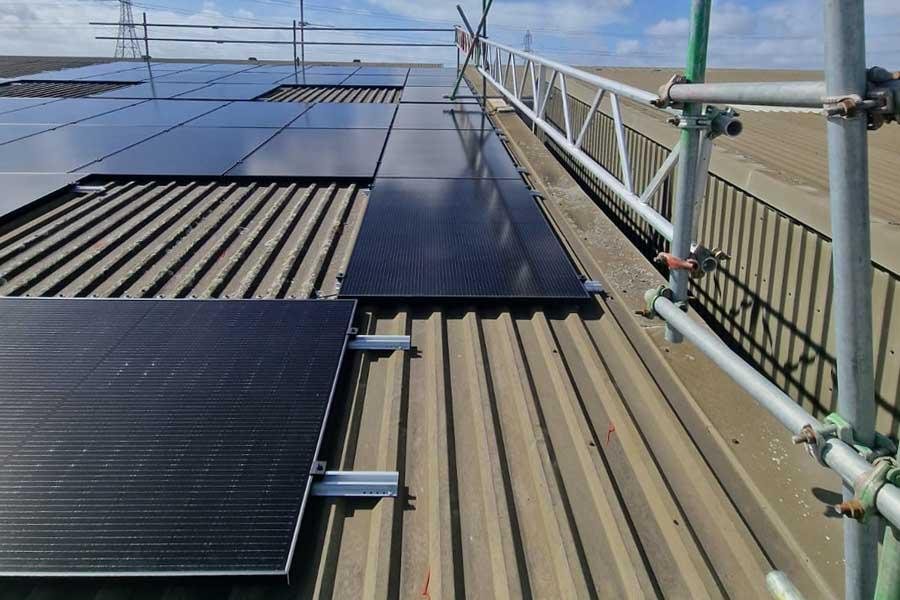
A 500kW solar installation and an in-house effluent treatment plant are part of how we run our Karachi facility — reducing reliance on grid power and treating process water before it leaves our site.
Panels are mounted directly on the factory roof, supplying a share of the electricity our weaving, dyeing and finishing floors run on day to day.
The CO₂ figure is a modeled estimate — 500kW capacity at a typical regional solar yield, offset against Pakistan's average grid emission factor — not a metered reading.
Terry towel production is energy-intensive — weaving looms, dyeing machines, dryers and finishing lines all draw significant power through the day. Solar generation offsets a portion of that load directly at the source.
Dyeing and wet processing generate wastewater — our in-house treatment plant processes it on site before discharge, rather than relying on external or municipal handling.
Process wastewater from dyeing and wet finishing is collected separately from general site drainage.
Physico-chemical treatment — screening, equalization, coagulation-flocculation and sedimentation — the standard process for textile dyeing effluent.
Treated water is tested against Pakistan's National Environmental Quality Standards (NEQS) for industrial liquid effluent.
Released only once it meets NEQS limits for pH, BOD, COD, TSS and other regulated parameters.
All dyestuffs and chemicals used in our dyeing process are azo-free, in line with international restricted-substance standards.
Our Standard 100 certification covers the strictest class of testing, applied to products made for babies and small children.
Weaving, dyeing and finishing under one roof means shorter transport distances between production stages compared to outsourced, multi-site supply chains.
Happy to share further detail on our solar installation, effluent treatment process and compliance documentation on request.